
To Feed the Future, Canada Must Broaden Its Definition of Food Innovation
Canada could become a key global food provider, but its food system is full of contradictions and inequalities.
This article calls for a broader definition of innovation beyond technology, including traditional knowledge, new economic models, and more sustainable solutions.



Over the coming century, Canada is set to become a critical global provider of food, whether we are ready or not. Many regions around the world are poised to lose farming capacity as the impacts of climate change accrue and accelerate. Up here, though, we have copious water, arable land, extensive coastal and marine food resources, and access to global shipping routes, bolstered by the potential for agriculture to grow in new zones as the planet warms. Canada’s capacity in global agrifood is likely to move beyond an opportunity to become an onus.
Why Food Innovation Must Go Beyond Technology

It is quite the challenge for a country that produces an abundance of food yet remains heavily reliant on imports, while many communities still struggle with equitable access to affordable, nutritious food. We will clearly need to innovate. For many, this immediately brings to mind ag-tech innovations like robotic harvesters, AI-integrated greenhouses and lab-grown meat.
But innovation is also about approach and technique. It is adapting Indigenous knowledge and traditional methods to new environments. It is using old technologies in new ways, finding new uses for waste products, and creating new funding pathways. We need to embrace innovation in all its forms if we are to feed the world without destroying the planet.
For World Hunger Day, here are three areas where a broader concept of innovation can help address hunger while braiding in major environmental and economic advantages.
Innovative Financing for Sustainable Farming
Food production is an intractable GHG emitter and the leading cause of global biodiversity loss. It is also a figurative Swiss army knife of possible solutions that can improve food security, the environment and nature. To maximize that potential, we need innovations in finance and policy.
The promise of agricultural carbon sequestration is a good example. Until we can successfully measure, report and verify things like the carbon and biomass content of soils, the creation of a reward system for farmers implementing soil-healthy practices is stymied. That reduces the capacity for farmers to invest in sustainable farming methods.
Similarly, climate-smart actions on farms have huge benefits for nearby ecosystems and communities, such as supporting biodiversity through buffers or reducing watershed flood risk. Developing payment mechanisms or finance markets for climate-smart agriculture and ecosystem services can move us towards a system where sustainable practices are the rational choice for economic viability and long-term productivity. That protects our food today, while investing in the land that will provide food tomorrow.
Reducing Food Waste Through Innovation
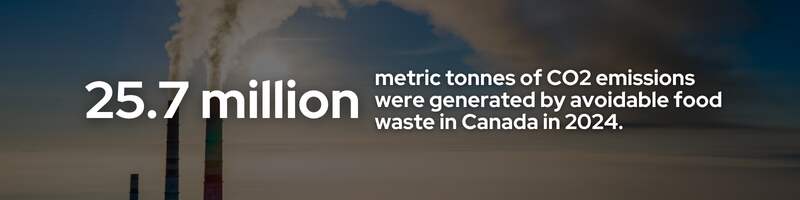
Despite the tremendous amount of food produced and available in Canada, more than 46% of it is wasted each year. In 2024, a whopping 41% of total food waste could have been avoided; instead, it generated 25.7 million metric tonnes of CO2 emissions. Meanwhile, 24% of people in Canada—9.8 million individuals—lived in a food-insecure household in 2025, with more than 2 million visits made to food banks across the country.
“This mismatch between food available and food eaten is partly the result of a focus on streamlined supply management, which supports the profitability of businesses but not always the needs of people.”
This mismatch between food available and food eaten is partly the result of a focus on streamlined supply management, which supports the profitability of businesses but not always the needs of people. Solving this mismatch is often a task left to community and hunger relief organizations, which are typically charities and non-profits relying on precarious funding sources.
What has resulted is an entire ‘other’ system ripe with innovative ideas, solutions and responses to the everyday crises faced by a quarter of the Canadian population. This system plays a huge role in getting otherwise-unwanted food to people who are hungry, thereby diverting waste and reducing resulting GHG emissions.
Building Infrastructure for Food Innovation
The food system is vast and complex, making it well-positioned to support projects across sectors and scales. This includes multi-use infrastructure like trade corridors that serve both agri-food and defence needs, as well as decentralized food storage and processing that help producers add value and improve local food access for communities.
But building physical infrastructure is only part of the innovation we need; supporting the people who run those facilities is another. Operational funding can extend the life of built infrastructure by making sure it is staffed, used and maintained. Too often, community-based projects are not eligible for operational support. This is a critical gap, especially when such projects are known to foster increased economic benefits to the communities they serve. Governments and funding bodies should be innovative in how projects are funded in development and over project life spans.
Canada is covered by another form of infrastructure that is begging for deeper and broader use. The charitable food system, originally set up as an emergency backstop, now exists in every part of Canada, including places the industrial food system doesn’t reach. The food unaffordability crisis and the resulting surge in food bank use have revealed to many Canadians that this alternative system has become essential infrastructure.
These informal networks have built a parallel system, sitting beside the industrial system, complete with their own warehousing facilities, commercial kitchens, trucking and logistics solutions, and cold chain management. And this sector is unrivalled in its ability to pivot as situations evolve, resource constraints grow tighter, or new cracks emerge in the foundation of the food system.
“Finding ways to braid the industrial and alternative systems together and, crucially, investing in both, is a powerful and innovative pathway to address hunger.”
The result is a robust system of collaborative resource sharing and distribution ingenuity. These networks provide an opportunity to learn and reconsider what forms of innovation exist. Finding ways to braid the industrial and alternative systems together and, crucially, investing in both, is a powerful and innovative pathway to address hunger.
Canada Must Strengthen Domestic Food Security Now
In recent months, the vulnerability of Canada’s current food system has become uncomfortably acute. Most of Canada’s fruits and vegetables either come from, or transit through, the United States, a historic supply pathway that now looks increasingly creaky. Meanwhile, the Middle East conflict carries heavy implications for food production and food affordability around the world.
It’s clear we need to strengthen our domestic food supplies and be part of a global food response. Canada can do this. We have educated and skilled people, a bounty of land and water, a strong democracy, and we hold adequate food as a human right.
But it will only work if we get creative and if we work together. We can embed food security into high-level government policies and enable local solutions. We can protect land for nature, biodiversity and future food needs, and build economic systems that compensate producers for the ecosystem services they provide. And we can understand that infrastructure is social as well as physical.
No matter the affiliation, Canadian governments, industry, financiers, farmers and communities can all agree on one thing: hunger has no place here. Not now. Not ever.
About the Experts
-

Tenille Bonoguore is Strategic Initiatives Lead at the Arrell Food Institute, where she focuses on strategy and collaboration to advance sustainable food systems. Her background spans climate policy, municipal governance, journalism and science communication. Bonoguore also served as one of Australia’s agriculture negotiators at COP29 and contributes to climate and food security initiatives internationally.
The Arrell Food Institute is a research institute at the University of Guelph focused on improving the sustainability, resilience, and equity of global food systems. The institute brings together researchers, industry leaders, policymakers, and community organizations to address challenges related to food security, agricultural innovation, climate resilience, and public policy. Its work supports interdisciplinary research, knowledge mobilization, and collaboration across the agri-food sector in Canada and internationally.
See more -

Pauline Cripps is Community Food Lead at the Arrell Food Institute, where she works on food security, systems resilience and community collaboration initiatives. She previously spent nearly a decade with the Guelph Food Bank, bringing frontline experience in hunger relief and food access programming alongside expertise in community-based food systems development.
The Arrell Food Institute is a research institute at the University of Guelph focused on improving the sustainability, resilience, and equity of global food systems. The institute brings together researchers, industry leaders, policymakers, and community organizations to address challenges related to food security, agricultural innovation, climate resilience, and public policy. Its work supports interdisciplinary research, knowledge mobilization, and collaboration across the agri-food sector in Canada and internationally.
See more -

Evan Fraser is Executive Director of the Arrell Food Institute at the University of Guelph and a professor specializing in food systems, sustainability, and global food security. His research examines the resilience of agri-food systems in the face of climate change, population growth, and economic disruption, and he is widely published on food policy and agricultural innovation.
The Arrell Food Institute is a research institute at the University of Guelph focused on improving the sustainability, resilience, and equity of global food systems. The institute brings together researchers, industry leaders, policymakers, and community organizations to address challenges related to food security, agricultural innovation, climate resilience, and public policy. Its work supports interdisciplinary research, knowledge mobilization, and collaboration across the agri-food sector in Canada and internationally.
See more
-
 We Need an Accountable Federal Response to Food Insecurity in Canada
 Valerie Tarasuk
Founding Investigator
PROOF
Valerie Tarasuk
Founding Investigator
PROOF
 Lynn McIntyre
Founding Investigator
PROOF
Lynn McIntyre
Founding Investigator
PROOF
-
 Canada Now Has Commercially Viable Food Security Solutions. Will We Scale Them Here?
 Benjamin Feagin Jr.
CEO
AgriTech North
Benjamin Feagin Jr.
CEO
AgriTech North
-
 On World Hunger Day, Hunger Is Still a Policy Choice
 Nick Saul
Co-Founder & CEO
Right to Food
Nick Saul
Co-Founder & CEO
Right to Food