
Canada Needs Nuclear Energy to Meet the AI Moment

As the green energy transition picks up steam and artificial intelligence investment booms, government officials, business leaders, and environmental groups are grappling with how to supply energy-hungry communities with the clean energy needed to power EVs, heat homes, and keep our industries firing on all cylinders.
Canada’s electricity needs are set to double by 2050, and provincial grids are already under pressure. Already, Canadian public utilities are having to ration electricity, even as they vow to bring new output online.
But if we are to meet the projected electricity demands of the burgeoning AI sector alone, we need our governments to take bold action and invest heavily in nuclear energy.
The Growth of AI and Its Energy Needs

Globally, the advent of commercial AI has dramatically altered the energy outlook. Projections from the International Energy Agency also see consumption doubling by the end of 2026 because the technology relies on reems of energy-intensive data centers, the likes of which we have not witnessed before.
Canada has made clear it intends to build on its early success to remain a player in the sector. It was the first country in the world to introduce a national AI strategy and has already invested over $2 billion in the sector since 2017.
“The advent of commercial AI has dramatically altered the energy outlook. Projections from the International Energy Agency also see consumption doubling by the end of 2026 because the technology relies on reems of energy-intensive data centers, the likes of which we have not witnessed before.”
There are already 239 data centers in Canada and counting. Our country’s up-until-now abundant clean energy supply and cooler climate make it an ideal location to invest in, with multiple provinces hungry for the opportunity to host.
Hydroelectricity, wind and solar will continue to play important roles in supplying the clean energy we need to remain competitive. However, new investments in hydroelectric dams face land ownership and environmental rights, while wind and solar rely too heavily on the elements.
Meanwhile, Canada possesses proven, reliable and emissions-free nuclear technology that can be deployed to supply the grid with the baseload energy it needs to meet the moment.
Canada’s Nuclear Opportunity
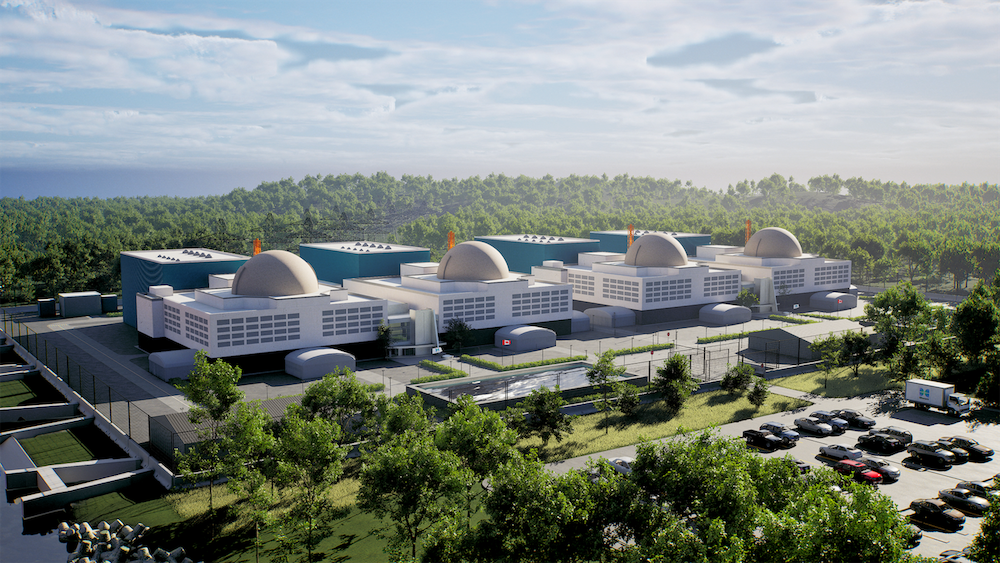
South of the border, we are seeing significant nuclear energy investment from private companies to help power their ambitious AI initiatives. Earlier this year, Amazon announced a major nuclear-powered data centre purchase in Pennsylvania and Google CEO Sundar Pichai said in an interview that his company was looking at using nuclear energy to meet its electricity needs. Microsoft co-founder Bill Gates has also invested $1 billion in a nuclear power plant in Wyoming that will one day help power the country’s massive AI and data center needs.
For decades, nuclear energy has reliably and safely accounted for well over half of Ontario’s electricity needs. Wisely recognizing its comparative advantage, the Ontario government has indicated nuclear energy will supply the biggest portion of the province’s additional power needs. But Canada needs more.
“If Canada wants to compete on the AI world stage and continue to attract some of the world’s biggest investments, it must bet on itself. Only through the wide deployment of new nuclear reactors will we be able to become a clean AI powerhouse.”
Only a handful of countries can boast domestic nuclear technology. Canada happens to be one of them, having developed CANDU nuclear technology in the 1950s. Today, CANDU reactors account for all of Canada’s nuclear production, and are operated in seven other countries.
If Canada wants to compete on the AI world stage and continue to attract some of the world’s biggest investments, it must bet on itself. Only through the wide deployment of new nuclear reactors will we be able to become a clean AI powerhouse.
-
 Smart Buildings in Canada: The Key to Achieving Net-Zero Emissions
 Peter Lukacko
VP, Smart Infrastructure
Siemens Canada
Peter Lukacko
VP, Smart Infrastructure
Siemens Canada
-
 An East-West Oil Pipeline Would be a Failure of National Imagination
 Jatin Nathwani
Professor Emeritus
University of Waterloo
Jatin Nathwani
Professor Emeritus
University of Waterloo
-
 Powering the Future: How Canada Can Lead in Energy Storage Innovation
 Justin W. Rangooni
President and CEO
Energy Storage Canada
Justin W. Rangooni
President and CEO
Energy Storage Canada