
IVF Funding Is Just the Beginning: A Wake-Up Call for Canada’s Future Healthcare Economy
Publicly funded IVF is a milestone-but it’s only the beginning. Canada must treat fertility as a national health and economic priority, not a private concern.

For decades, fertility has been treated as a niche topic; an emotional and often private concern for individuals or couples. That perception is rapidly changing. With British Columbia (BC) recently introducing a publicly funded IVF program, we’re witnessing a broader shift. Infertility and reproductive health are finally being recognized as central to Canada’s healthcare conversation and to its economic future.
The new investment is significant. The BC government will offer up to $19,000 in fertility funding for eligible residents, making advanced reproductive treatments more accessible for thousands. Public funding for those struggling to conceive sends a powerful signal that fertility is not a luxury; it’s healthcare.
However, if we stop there, we miss the bigger picture across the nation.
Infertility is on the rise. What was once a one in 12 issue is now one in six, and climbing, according to the World Health Organization (WHO).
We must treat fertility not just as a personal consideration, but as a public indicator that tells us how well our health systems and policies are serving the next generation.
Infertility Isn’t Just a Women’s Issue: It’s Time to Rethink the Narrative

One of the most persistent myths in reproductive care is that infertility is a woman’s issue. As a fertility specialist, I see the consequences of this misunderstanding: delayed testing for male partners, misconceptions, and overlooked diagnoses.
The truth is more balanced. Overall, one-third of infertility cases are caused by male reproductive factors, one-third by female factors, and the remaining third by both male and female reproductive issues or by unknown factors.
“65% of Canadians now recognize that infertility affects both men and women equally.”
Encouragingly, public understanding is shifting. Grace Fertility recently commissioned a survey alongside clinics across the country, and the report revealed that 65% of Canadians now recognize that infertility affects both men and women equally. That’s a vital first step.
Fertility care cannot remain siloed under women’s health in our policy and planning models. It must be approached as a shared responsibility that includes men, couples, and our entire healthcare system.
Fertility Preservation: An Economic Imperative, Not a Luxury
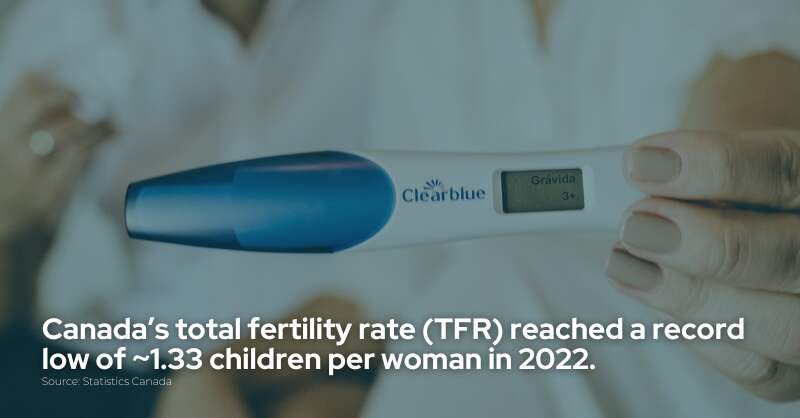
Fertility preservation is no longer just a medical decision; it’s becoming a strategic part of economic planning. By freezing eggs, sperm, or embryos, people can take control of their reproductive future.
Egg freezing, for example, allows individuals to preserve their current fertility to optimize their choices later in life. Elective egg freezing is often recommended before treatments like chemotherapy or ovarian surgery. Still, more people are now choosing it for personal reasons, giving themselves more time and flexibility to start a family. Men can also freeze sperm as a precaution in case of future fertility issues.
Nearly half of the Canadians we surveyed believe family planning conversations should start between the ages of 25 and 30. That’s promising, but science suggests we need to go even further. By educating young adults about their reproductive timelines and options, we can empower them to make informed choices before their fertility declines.
People who delay childbearing often do so for education, career, medical or financial reasons. If we don’t offer reproductive flexibility, we risk forcing people into choosing between their goals and their families. That’s a false choice and one that disproportionately affects women’s career paths and earning potential.
A Word of Caution on Public Funding: Don’t Delay
“Whether funded privately or publicly, IVF is a medical decision, not a financial one. Your body doesn’t wait for policy.”
The promise of public funding is real, but it comes with a cautionary tale. Quebec became the first Canadian province (and a first in North America) to offer public funding for IVF in August 2010. When Quebec first introduced public IVF coverage, we saw many patients delay treatment in hopes of accessing free care. Unfortunately, for those in their late 30s or early 40s, that delay significantly reduced their chances of success.
Fertility is one of the few areas in medicine where time is not irrelevant. Time is actually the most critical factor. My strongest advice to patients is simple: do not wait. Begin diagnostic testing now. Book your consultations. Understand your options. The earlier you begin, the more control you have.
Whether funded privately or publicly, IVF is a medical decision, not a financial one. Your body doesn’t wait for policy.
IVF as Innovation: The Role of Technology in Our Future Economy
“By treating IVF and fertility preservation as platforms for medical innovation, we open the door to new biotech partnerships, research and development investment, and the development of exportable technologies that support our healthcare economy.”
IVF today is a science-driven, data-enhanced, and advanced form of medicine. It’s an arena of healthcare innovation with implications far beyond reproductive health.
Innovations like EMBRACE (Embryo Analysis of Culture Environment), a noninvasive genetic screening and testing method, can analyze DNA from the fluid surrounding the embryo without a biopsy. EMBRACE helps prioritize the healthiest embryos to maximize success in IVF treatment, without harming the embryo itself, significantly improving outcomes.
Innovations like these are already contributing to higher success rates, fewer complications, and more cost-effective treatments. They also position Canada to be a global leader in fertility technology if we invest accordingly.
By treating IVF and fertility preservation as platforms for medical innovation, we open the door to new biotech partnerships, research and development investment, and the development of exportable technologies that support our healthcare economy.
Fertility innovations are frontier science and belong in the same conversation as genomics, AI diagnostics, and personalized medicine. Supporting it isn’t just good for families. It’s good for the future of healthcare.
National Policy Must Catch Up
While BC’s investment is a major milestone, it also highlights a fragmented system. Across Canada, access to fertility treatment is a patchwork of private clinics, provincial regulations, and unequal funding.
We need a national strategy for fertility care that standardizes access, supports innovation, and includes fertility preservation in the conversation. We need to expand public funding to include not just IVF but egg and sperm freezing. We need to update national clinical guidelines to reflect the realities of delayed parenthood. We must include men more explicitly in fertility assessment and education. Finally, we have a responsibility to continue accelerating research and development in fertility testing and diagnostics.
Canada has the opportunity to lead in treating infertility and in redefining what a modern, inclusive, and future-ready healthcare system looks like.
Your Future Family Is Worth Planning For
“This is what the future of healthcare looks like. It is proactive, personalized, and inclusive of reproductive health at every stage of life.”
Whether you’re 25 or 45, single or partnered, ready to conceive or simply thinking ahead, there’s no wrong time to get informed. Fertility care is not only for people in crisis. It’s for anyone who wants options.
This is what the future of healthcare looks like. It is proactive, personalized, and inclusive of reproductive health at every stage of life.
BC’s new IVF funding program is an encouraging step. However, it’s important that we do not treat it as the finish line. It’s the beginning of a much larger shift where we treat reproductive health not as a side issue but as a central pillar of our healthcare and economic planning.
The future of our country depends on the choices we give the next generation and on the families they hope to build.
About the Expert
-

Dr. Ghadeer Akbar is a fertility specialist at Grace Fertility, a full-service fertility centre in the heart of Vancouver, offering a complete range of fertility assessments and advanced treatments. Grace Fertility provides patients the attention they need with a personal touch, with a high degree of direct interaction. Dr. Akbar has a vested interest in fertility preservation for women and couples, and is fluent in Farsi, Arabic, and English. Dr. Ghadeer Akbar completed her 5-year residency in Obstetrics and Gynecology at McGill University in Montreal obtaining her first Canadian Board in 2011 and subsequently completed a Fellowship at the University of British Columbia in Gynecologic Reproductive Endocrinology and Infertility (GREI). Following her Fellowship, Dr. Akbar returned to Kuwait where she was the Head of the Infertility and IUI Unit at Farwaniya Hospital as well as providing service at Dar Al Shifaa Hospital in IVF and general gynecology, two of the largest hospitals in Kuwait.
See more
-
 Innovation Is Not Guaranteed: Canada’s Life Sciences Moment
 David D. Jones
Managing Director
Merck Canada
David D. Jones
Managing Director
Merck Canada
-
 We Need an Accountable Federal Response to Food Insecurity in Canada
 Valerie Tarasuk
Founding Investigator
PROOF
Valerie Tarasuk
Founding Investigator
PROOF
 Lynn McIntyre
Founding Investigator
PROOF
Lynn McIntyre
Founding Investigator
PROOF
-
 The Economic Impact of Menopause: How Sleep Disruption Affects Canada’s Workforce
 Michelle Jacobson
Co-Founder
Coven Women's Health
Michelle Jacobson
Co-Founder
Coven Women's Health