
A Burning Issue: Canada’s Excise Stamps are a Self-Inflicted Absurdity

It’s 8 AM at Northern Bloom Cannabis, our imaginary mid-sized producer in Ontario. Emma, the operations manager, stands in the warehouse surveying a problem that shouldn’t exist.
“The order for British Columbia got cancelled and redirected to Alberta,” she explains with a sigh. “Now we need to remove 2,000 British Columbia excise stamps and replace them with Alberta ones.”
This isn’t an unusual occurrence in Canada’s cannabis industry. It’s a regular, costly dance performed by every producer in the country, thanks to one of the most perplexing examples of bureaucratic self-sabotage in Canada: our multi-provincial excise stamp system.
While the cannabis sector faces significant challenges—from combating the illicit market to ensuring Canadian companies can become global leaders—this absurd internal trade barrier perfectly illustrates the issues plaguing our industry.
The 13 Stamps of Regulatory Christmas
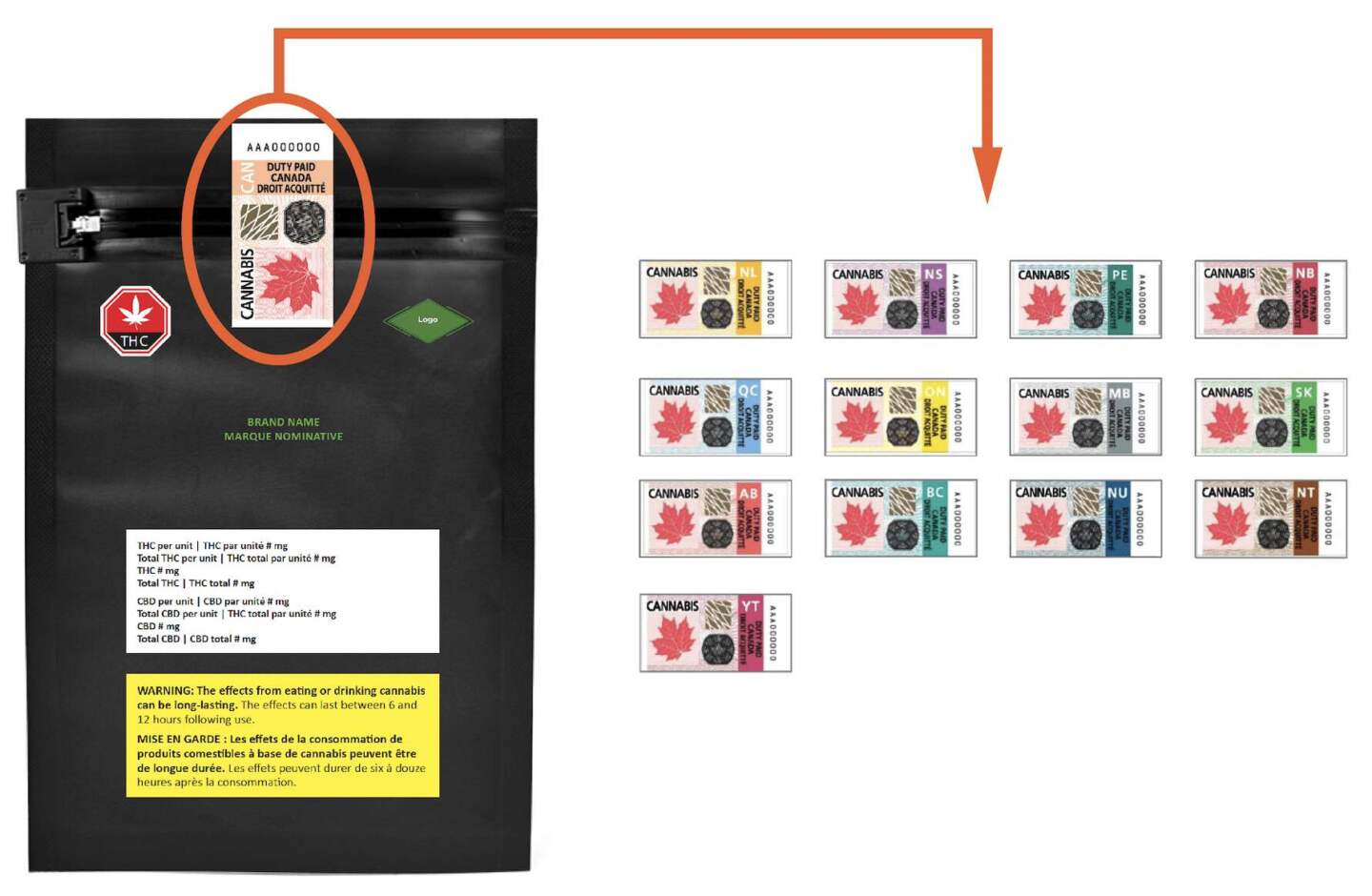
Unlike other federally regulated industries, cannabis producers must affix different excise stamps depending on which province or territory will sell the product. That’s 13 different stamps for 13 different jurisdictions—all issued by the same federal agency.
“The Canada Revenue Agency (CRA) issues 13 different excise stamps, despite being a single federal entity overseeing an ostensibly single market.”
Yes, you read that correctly. The Canada Revenue Agency (CRA) issues 13 different excise stamps, despite being a single federal entity overseeing an ostensibly single market.
Back at Northern Bloom, three employees have been assigned to carefully remove those British Columbia stamps from perfectly good products. And they can’t simply discard the removed stamps—they must save them for CRA inspection. This is especially challenging as cannabis products come in various shapes and sizes.
“We have to store them properly until the CRA agent comes for verification,” Emma notes to the three employees. “Then they burn them. And then they sell us some more.”
“The CRA literally burns federal tax stamps. Then, the CRA sells the company new stamps to replace the ones they just incinerated.”
Let’s pause to appreciate this moment. The CRA literally burns federal tax stamps. Then, the CRA sells the company new stamps to replace the ones they just incinerated.
Emma knows that cannabis and protection rackets used to go hand-in-hand before legalization in 2018. It’s part of why she got into the industry: to move it away from criminal hands. To protect children. To serve our country’s economy rather than leech off the side. But now it appears the government is, willfully or not, engaging in a racket of its own.
The Stamp Shuffle

The reallocation of products across provinces happens frequently in the cannabis industry. Demand fluctuates, and efficient supply chain management requires flexibility. Instead, producers face rigid barriers created not by provincial disagreements but by a self-imposed federal requirement.
Sometimes, Emma needs to redirect inventory to match demand. For another example, let’s say Northern Bloom’s original projection had 1,000 units for Ontario and 800 for Quebec, but actual orders come in at 950 for Ontario and 850 for Quebec. Logic would suggest they’d just ship 50 units from their Ontario allocation to Quebec and find.
Logic, however, has little place in this system.
Instead, someone must physically remove 50 Ontario stamps from products, apply 50 Quebec stamps, and save those Ontario stamps for eventual ceremonial burning. Meanwhile, inventory sits idle, taking up valuable warehouse space and tying up capital.
“One producer estimates that this unnecessary process costs them around $6M annually. That’s just one company. Industry-wide, we’re wasting tens of millions of dollars on this absurdity.”
The economic impact is substantial. One producer estimates that this unnecessary process costs them around $6M annually. That’s just one company. Industry-wide, we’re wasting tens of millions of dollars on this absurdity.
The Real Cost
When cannabis products don’t completely sell out in their designated province, producers must determine whether to go through the expensive process of removing and replacing stamps. Often, it’s more cost-effective to simply destroy the product.
“In Canada, where we worry about sustainability and economic efficiency, companies are destroying perfectly good products because the federal government has created an artificial barrier to interprovincial trade.”
Let that sink in. In Canada, where we worry about sustainability and economic efficiency, companies are destroying perfectly good products because the federal government has created an artificial barrier to interprovincial trade.
Every additional step—removal, replacement, restorage—adds labour and logistical costs, impacting the bottom line for businesses and consumers alike. Producers face squeezed margins, threatening their ability to stay in business. Consumers, in turn, face higher prices at checkout.
And remember, all this happens while the illicit market—which, of course, faces none of these regulatory hurdles—continues to thrive.
The Solution
The solution is simple, obvious, and overdue: a national excise stamp that applies to all provinces and territories.
“A national stamp would mean no more stopping and starting production lines, no more complex storage requirements, and no more costly manual restamping.”
This would streamline production, reduce costs, improve efficiency, and eliminate an unnecessary internal trade barrier. A national stamp would mean no more stopping and starting production lines, no more complex storage requirements, and no more costly manual restamping.
In the 2024 Fall Economic Statement, the federal government announced their “intent to explore a transition” to a single stamp, with “more details” promised in Budget 2025.
The government “intends to explore?” Well, if I had considered the possibility of investigating the idea of writing this article, I’d probably never have written it. This isn’t a deep-sea expedition or space travel. This is fixing an obviously flawed system that the government itself created.
When I asked an executive at one of Canada’s largest provincial distributors whether they would object to a national stamp, their response was immediate: “Absolutely not. It would make everyone’s lives easier.”
The Burning Question
As the CRA agent stands in Northern Bloom’s parking lot, packing up the stamps for the bonfire, Emma approaches.
“Seems like a waste, doesn’t it?” she asks.
The agent shrugs. “Policy is policy.”
“By the way,” he adds, reaching into his bag, “how about some new stamps? Will that be cash, cheque, or credit card?” Emma grimaces. For a second, she wonders: wouldn’t it be easier just to go under the table? She stops herself and laughs at the irony.
“What’s so funny?” the agent asks.
“Nothing,” she says. “Just thinking of greener pastures.”
This scene plays out across the country every day. Canadian businesses waste time and money on an internal trade barrier created by the very government that claims to support them.
“While the illicit market operates without these constraints and international markets beckon Canadian cannabis companies, our own government “intends to explore” picking the lowest-hanging fruit.”
The cannabis sector needs a fresh set of eyes on it. We’ve learned many lessons in the seven years since recreational legalization, but we haven’t adopted those lessons into meaningful change.
While the illicit market operates without these constraints and international markets beckon Canadian cannabis companies, our own government “intends to explore” picking the lowest-hanging fruit.
In an era of economic uncertainty and increasing global competition, Canada cannot afford to maintain self-imposed barriers that suffocate our industry and hold back our companies. We need action. We can start with the excise stamps.
A national excise stamp isn’t just about simplifying logistics. It’s about demonstrating that our government can recognize and fix simple mistakes as a step toward solving the more foundational challenges to our industry.
“If we can’t fix something as obvious as the stamp, how will we deal with the real issues which are preventing the success of this industry, such as excessively high tax rates and a prolific illicit market.”
And if we can’t fix something as obvious as the stamp, how will we deal with the real issues which are preventing the success of this industry, such as excessively high tax rates and a prolific illicit market.
It’s time to give Emma a break and stop burning opportunities. It’s time to reclaim first place. It’s well past time for a national excise stamp.
-
 Can Industrial Hemp Accelerate Canada’s Green Economy?
 Darren Bondar
President and CEO
HEMPALTA
Darren Bondar
President and CEO
HEMPALTA
-
 Repositioning Cannabis: A Policy, Public Health, and Economic Discussion
 Tabitha Davis
Director of Regulatory and Government Relations
SNDL
Tabitha Davis
Director of Regulatory and Government Relations
SNDL
-
 Canada Should Seize Opportunity Presented by Booming German Medical Market
 Raj Grover
CEO
High Tide
Raj Grover
CEO
High Tide